

zarządzenie nr 91/2026 zmieniające zarządzenie w sprawie przeciwdziałania praktykom dyskryminacji i mobbingowi w Akademii Nauk Stosowanych w Koninie
zarządzenie nr 1/2020 w sprawie przeciwdziałania praktykom dyskryminacji w Państwowej Wyższej Szkole Zawodowej w Koninie
zarządzenie nr 95/2020 w sprawie powołania Pełnomocnika Rektora ds. Przeciwdziałania Dyskryminacji w Państwowej Wyższej Szkole Zawodowej w Koninie
zarządzenie nr 6/2021 zmieniające zarządzenie w sprawie powołania Komisji ds. Przeciwdziałania Dyskryminacji w Państwowej Wyższej Szkole Zawodowej w Koninie
zarządzenie nr 68/2026 w sprawie przeciwdziałania praktykom dyskryminacji i mobbingowi w Akademii Nauk Stosowanych w Koninie
zarządzenie nr 69/2026 zmieniające zarządzenie w sprawie powołania Pełnomocnika Rektora ds. Przeciwdziałania Dyskryminacji w Akademii Nauk Stosowanych w Koninie
zarządzenie nr 70/2026 w sprawie powołania Komisji ds. Przeciwdziałania Dyskryminacji i Mobbingowi w Akademii Nauk Stosowanych w Koninie
Pełnomocnik rektora ds. przeciwdziałania dyskryminacji i mobbingowi
dr hab. Jakub Bartoszewski, prof. ANS w Koninie
adres e-mail:
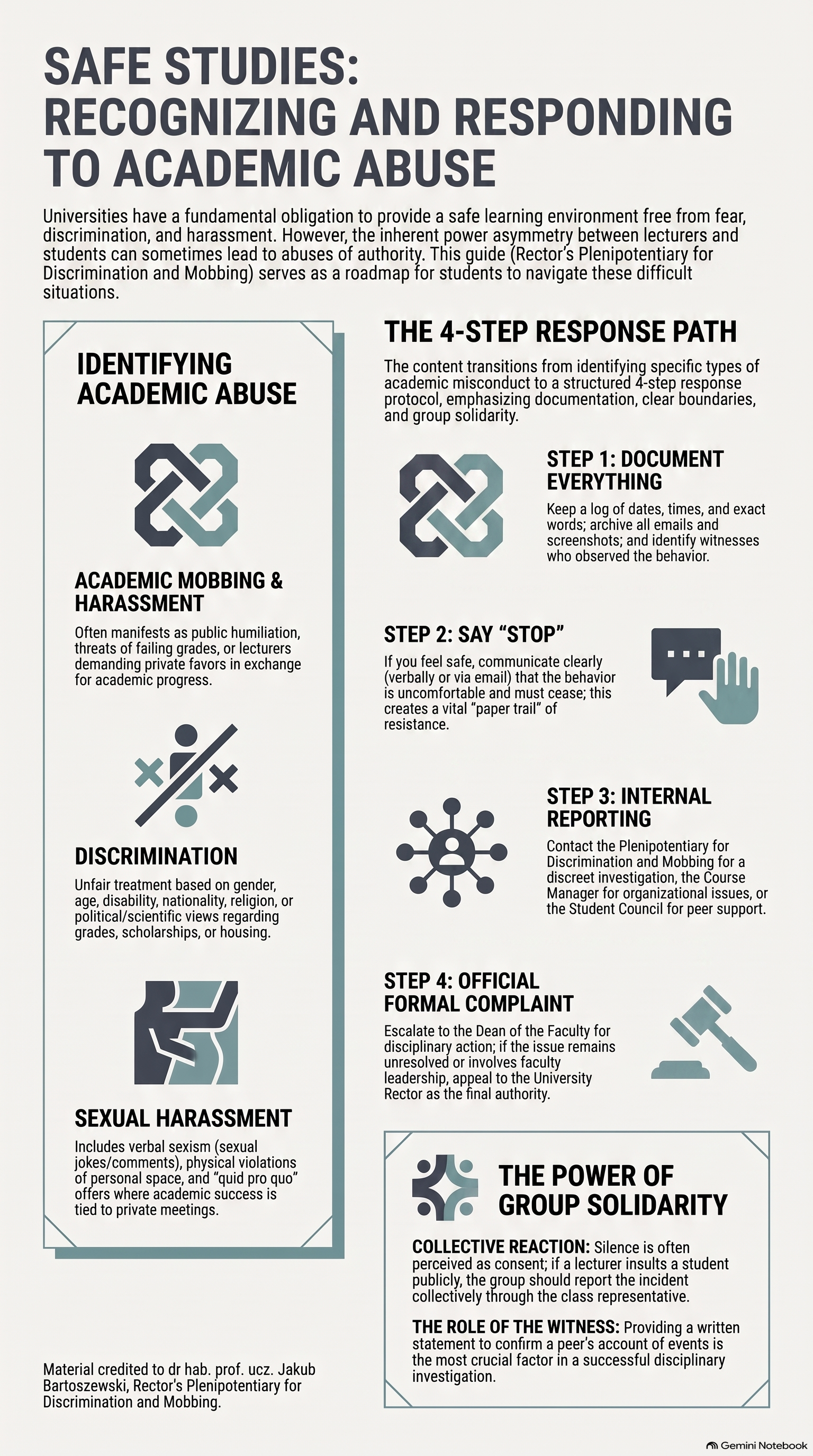
Poradnik - dyskryminacja/nierówne traktowanie/mobbing
Instrukcja dotycząca zagrożeń oraz problemów neuroróżnorodnych w ANS w Koninie
PROGRAM WARSZTATÓW
W ROKU AKADEMICKIM 2026/2027
SEMESTR ZIMOWY
podnoszenie kompetencji w zakresie zjawisk niepożądanych z uwzględnieniem specyficznych potrzeb osób neuroróżnorodnych
Zgodnie z Zarządzeniem NR 66/2025 z dnia 31 lipca 2025 roku oraz Zarządzeniem NR 68/2026 z dnia 3 sierpnia 2026 r.
Zasadniczym założeniem Programu jest wzmocnienie potencjału pracowników, studentów poprzez wzmocnienie wiedzy, umiejętności i kompetencji w zakresie mobbingu i dyskryminacji, molestowania seksualnego oraz problemów neuroróżnorodnych w Akademii Nauk Stosowanych w Koninie.
Tematyka warsztatów:
|
Lp. |
Nazwa warsztatu |
Osoba prowadząca |
Termin |
|
01 |
Zaburzenie a standardy pracy: Strategie przezwyciężania trudnych zachowań |
Dr hab. Jakub Bartoszewski, prof. ANS |
23.10.2026r. Godz. 17:00 |
|
02 |
Granice w miejscu pracy – mobbing, dyskryminacja i molestowanie seksualne (w tym zmiany prawne) |
Dr hab. Jakub Bartoszewski, prof. ANS |
20.11.2026r. Godz. 17:00 |
|
03 |
Poza schematem, ale w granicach zasad: Jak wspierać pracowników w eliminowaniu zachowań dysfunkcyjnych |
Dr hab. Jakub Bartoszewski, prof. ANS |
04.12.2026r. Godz. 17:00 |
|
04 |
Bezpieczni i różnorodni: budowanie współpracy bez mobbingu, dyskryminacji i wykluczenia |
Dr hab. Jakub Bartoszewski, prof. ANS |
15.01.2027r. Godz. 17:00. |
I. Sposób realizacji treści: w realizacji programu zostaną wykorzystane materiały oparte na naukowych dowodach dostępnych na rynku wydawniczym oraz przepisach prawa aktualnie obowiązujących. By osiągnąć cele w postaci wyposażenia słuchaczy w wiedzę, umiejętności i kompetencję wykorzystane zostaną metody realizowane w ramach prac warsztatowych.
II. W przypadku studentów istnieje możliwość uzyskania potwierdzenia udziału w Programie.
III. Prowadzący: dr hab. Jakub Bartoszewski, prof. ANS.
IV. Link do warsztatów: https://teams.microsoft.com/meet/327248278727245?p=sGWibApfqtukcgpiIM
Studia to nie tylko nauka. Zadbaj o swoją „głowę” w tym roku akademickim!
Nowy semestr, przeprowadzka do innego miasta, presja wyników, niekończący się scroll w telefonie,
a w perspektywie – legendarna już sesja egzaminacyjna. Brzmi znajomo? Życie studenckie potrafi być ekscytujące, ale niesie też wyzwania, o których rzadko rozmawia się na tradycyjnych wykładach.
W natłoku kolokwiów i projektów łatwo zapomnieć o najważniejszym projekcie: o samym sobie.
Dlatego przygotowaliśmy dla Was cykl webinariów profilaktycznych i edukacyjnych. Bez nudnej teorii
– za to z konkretnymi narzędziami, wiedzą opartą na dowodach i przestrzenią na Wasze pytania. Sprawdźcie nasz harmonogram (terminy będą bezpośrednio przesyłane do studentów w systemie USOS)od października do lutego i zobaczcie, jak skutecznie hakować stres, budować zdrowe relacje i nie dać się zwariować cyfrowemu przebodźcowaniu.
|
Miesiąc |
Oficjalne dni zdrowia / święta |
Proponowany temat webinaru |
Kluczowe zagadnienia do omówienia ze studentami |
|
Październik |
Światowy Dzień Zdrowia Psychicznego |
„Studencki start: Jak zadbać o głowę w nowym roku akademickim?” |
Adaptacja do nowego środowiska, radzenie sobie z FOMO (lękiem przed odrzuceniem), budowanie zdrowych relacji rówieśniczych i asertywność. |
|
Listopad |
|
„Presja ciała i kryzys |
Przełamywanie tabu wokół depresji |
|
Grudzień |
Światowy Dzień Gier Wideo |
„W pętli dopaminy: Gaming, social media oraz mechanizmy ucieczki” |
Jak gry i media społecznościowe wpływają na układ nagrody. Pułapka „szybkiej dopaminy” a motywacja do nauki. Gdzie kończy się pasja, a zaczyna cyfrowe przebodźcowanie. |
|
Styczeń |
Międzynarodowy Dzień Walki z Depresją |
„Sezonowa depresja a zwykły spadek formy. Jak rozpoznać sygnały ostrzegawcze?” |
Różnice między obniżonym nastrojem a depresją kliniczną, gdzie szukać pomocy na uczelni, destygmatyzacja leczenia psychiatrycznego. |
|
Luty |
Tydzień Zdrowia Psychicznego Młodzieży |
„Sesja bez paniki: Stres egzaminacyjny, lęk przed porażką i prokrastynacja” |
Psychologiczne mechanizmy odkładania spraw na później (prokrastynacja), techniki radzenia sobie ze stresem pod presją czasu, profilaktyka zaburzeń lękowych. |
Warsztaty będą się odbywać on-line, link:
https://teams.microsoft.com/meet/327248278727245?p=sGWibApfqtukcgpiIM
Organizator: Pełnomocnik Rektora ds. dyskryminacji i mobbingu dr hab. Jakub Bartoszewski, prof. ANS; mail:
W razie pytań zapraszam na dyżur w każdy wtorek godzina 9:00-9:45
on-line: https://teams.microsoft.com/meet/327248278727245?p=sGWibApfqtukcgpiIM

Regulations introduced pursuant to Ordinance No. 68 of the Rector of the Academy of Applied Sciences in Konin of 3.08.2026 regarding counteracting discrimination and mobbing at the University and the procedure of conduct.
Chapter 2
§ 4
The University is obliged to undertake all legally permitted measures, consisting in particular of:
- promoting desirable attitudes and behaviors in relationships between employees, which comply with the principles of social coexistence;
- raising awareness about the phenomena of discrimination, harassment, and mobbing, methods for preventing their occurrence, and the consequences of such occurrence;
- monitoring the issues of discrimination, harassment, and mobbing, as well as applying anti-mobbing procedures in practice.
§ 5
- In order to counteract any instances of discrimination and mobbing, as well as their consequences, the Rector shall appoint:
- the Rector's Plenipotentiary for Anti-Discrimination and Anti-Mobbing at the ANS in Konin, hereinafter referred to as the „Plenipotentiary”;
- the Anti-Discrimination and Anti-Mobbing Committee at the ANS in Konin, hereinafter referred to as the „Committee”, consisting of:
a) the Rector's Plenipotentiary for Persons with Disabilities and Equal Treatment, acting as the Chairperson,
b) two academic teachers, including a psychologist or a psychotherapist,
c) an employee who is not an academic teacher,
d) a legal counsel or an attorney-at-law providing legal services to the "University". - The Plenipotentiary and the Committee, referred to in paragraph 1, shall cooperate in the fulfillment of their assigned tasks.
§ 6
- The Rector's Plenipotentiary for Anti-Discrimination and Anti-Mobbing acts as the first point of contact, whose task is to provide support and assistance to employees, associates, students, and lifelong learning participants in cases of discrimination, harassment, and mobbing on the University premises.
- The tasks of the Plenipotentiary include, in particular:
- developing an information program regarding discrimination, mobbing, and sexual harassment;
- creating a dedicated website with information on counteracting the phenomena of discrimination and mobbing (in both Polish and English);
- organizing legal and psychological assistance for victims of actions bearing the hallmarks of discrimination, harassment, or mobbing;
- organizing training courses, lectures, and workshops in the field of counteracting discrimination, mobbing, and harassment, including conducting systematic anti-discrimination and anti-mobbing activities.
§ 7
- The tasks of the Anti-Discrimination and Anti-Mobbing Committee include, in particular:
- examining filed complaints regarding discrimination, harassment, or mobbing;
- conducting mediation between the parties;
- implementing standards of equal treatment and counteracting discrimination, harassment, and mobbing within the University's academic community;
- developing a comprehensive program to enhance the anti-discrimination and anti-mobbing competencies of the entire University community;
- initiating information campaigns regarding the phenomena of discrimination, mobbing, and harassment, identifying problems related to these phenomena, and coordinating actions aimed at preventing them;
- monitoring and evaluating anti-discrimination and anti-mobbing activities.
- A member of the Committee shall be recused from participating in the examination of a case if the case concerns them personally, or concerns a person with whom they have a relationship that may raise doubts as to their impartiality, or when other circumstances exist that may justify such doubts. The decision on the recusal is made by the Chairperson of the Committee, and in the case of the Chairperson`s recusal – by the Rector.
- Retaliatory measures are prohibited against individuals who have filed a complaint regarding discrimination, harassment, or mobbing, participated in the investigation, or provided information related to the ongoing case.
§ 8
- Any person who believes they have been subjected to discrimination, harassment, mobbing, or unequal treatment, or who is or has been a witness to such actions, should report this fact in writing to the Rector in the form of a complaint.
- The complaint should contain:
- a statement of facts, indicating in particular the specific actions or behaviors considered by the reporting person to constitute discrimination, harassment, or mobbing, as well as the date or period to which these actions or behaviors relate;
- evidence supporting the cited circumstances, including the identification of witnesses;
- identification of the perpetrator or perpetrators of the discrimination, harassment, or mobbing;
- the date of submission of the complaint and a handwritten signature.
§ 9
- Within 5 business days from receipt of a complaint regarding discrimination, mobbing, or harassment, the Rector shall forward the case to the Committee, which shall establish the facts and assess whether the specified incident occurred.
- The Committee shall conduct the investigation without undue delay within 30 days from the date of receiving the complaint. In particularly justified cases, this period may be extended by the Rector for another 30 days.
- The examination of cases by the Committee shall be conducted in accordance with the principles of:
- promptness;
- confidentiality;
- impartiality.
- Subject to the applicable legal provisions, the head of each organizational unit and department is obliged, upon the request of the Committee, to present relevant documents and provide information related to the case conducted by the Committee.
- Persons performing activities in a case regarding reported discrimination, mobbing, or harassment are obliged to maintain confidentiality regarding all facts learned in the course thereof, as well as not to copy or distribute documents relating to the case. The data contained in the documents may constitute sensitive personal data and are subject to personal data protection in accordance with applicable regulations.
§ 10
- The Committee deliberates during meetings.
- Minutes shall be taken from each meeting, which shall be signed by all participants of the meeting.
- The Committee is authorized to:
- inspect documents necessary to clarify the case;
- hear the person making the report and the person accused of discrimination, harassment, or mobbing;
- summon and hear individuals indicated by the reporting person and the accused person as witnesses to the events;
- undertake other activities that would be of significant importance in clarifying the case.
- Before issuing an opinion, the Chairperson of the Committee shall give notice of the results of the proceedings and present the collected materials to the reporting person, the alleged perpetrator, and their superiors for review and to allow them to respond to their content within 14 days of receipt.
- The proceedings before the Committee shall conclude with the issuance of an opinion together with its justification, which the Chairperson of the Committee shall submit to the Rector within 14 days.
§ 11
If the Committee's opinion and the gathered material indicate that discrimination, harassment, unequal treatment, or mobbing has occurred, the Rector shall take measures provided for by legal provisions and the regulations in force at the University.